


Table of Contents
Running a hotel today is far more complex than it was a few years ago.
Hotels are no longer managing just reservations and check-ins. They are handling:
- Multiple booking platforms
- Real-time pricing updates
- Guest communication
- Online reputation
- Direct booking strategies
- Operational coordination across departments
At the same time, guest expectations continue to rise.
Travelers expect instant confirmations, seamless booking experiences, faster communication, and personalized service throughout their stay.
For many hotels, the biggest challenge isn’t hospitality — it’s operational complexity.
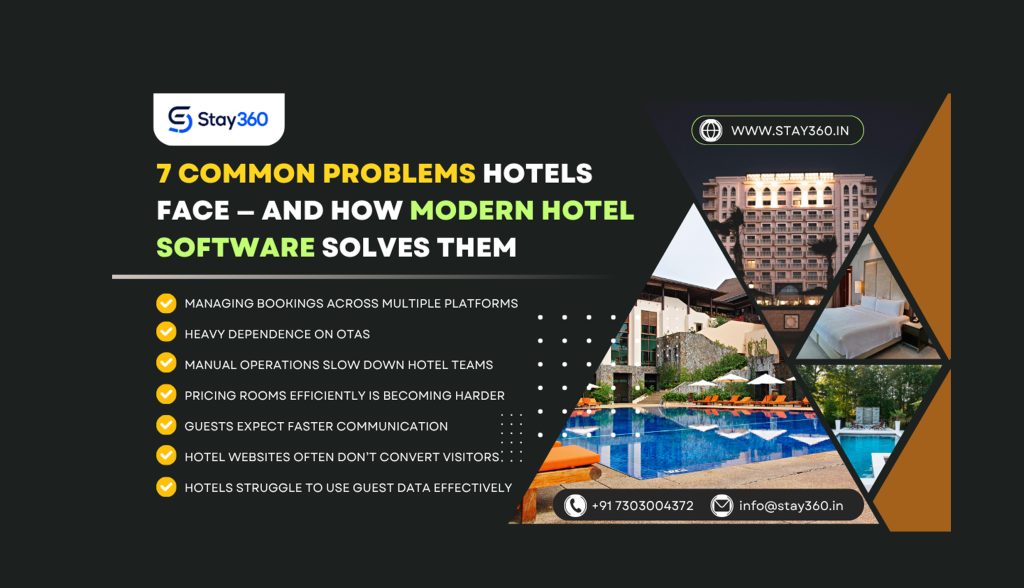
Here are some of the most common problems hotels face today and how modern hotel software helps solve them.
1. Managing Bookings Across Multiple Platforms
One of the biggest operational challenges for hotels is handling reservations from multiple channels.
Hotels often receive bookings from:
- OTAs
- Direct website bookings
- Phone inquiries
- Travel agents
- Google Hotel listings
Without centralized systems, managing room inventory manually becomes difficult and increases the risk of:
- Overbookings
- Inventory mismatches
- Delayed updates
- Revenue loss
Modern hotel software with integrated channel management automatically syncs inventory and rates across platforms in real time.
This helps hotels:
- Maintain accurate availability
- Reduce booking errors
- Simplify OTA management
- Save operational time
Many hospitality businesses are increasingly investing in connected booking infrastructure to support direct booking growth and OTA synchronization.
2. Heavy Dependence on OTAs
OTAs help hotels increase visibility, but high commission costs can impact profitability over time.
Many independent hotels still rely heavily on third-party platforms for bookings. Industry discussions show OTA dependency remains a major concern for hospitality businesses trying to improve margins.
Hotels are now focusing more on:
- Direct booking strategies
- Better booking experiences
- Mobile-friendly hotel websites
- Guest retention campaigns
Modern booking engines help hotels:
- Increase direct reservations
- Improve conversion rates
- Reduce commission dependency
- Build stronger guest relationships
Industry reports also show that hotels investing in website optimization and frictionless booking experiences continue to maintain stable direct bookings despite changing traveler behavior.
3. Manual Operations Slow Down Hotel Teams
Many hotels still manage daily operations manually or through disconnected systems.
This often creates:
- Slower front desk workflows
- Delayed housekeeping coordination
- Communication gaps between departments
- Repetitive administrative work
Modern Property Management Systems (PMS) help centralize operations through one dashboard.
Hotels can manage:
- Reservations
- Billing
- Housekeeping
- Guest profiles
- Reports & analytics
- Team coordination
Cloud-based hospitality platforms are becoming increasingly important because they allow hotels to manage operations more efficiently from one connected ecosystem.
4. Pricing Rooms Efficiently Is Becoming Harder
Hotel pricing changes constantly based on:
- Demand fluctuations
- Seasonality
- Local events
- Competitor pricing
- Occupancy levels
Static pricing strategies no longer work effectively in today’s hospitality market.
Modern revenue management systems help hotels:
- Optimize room pricing dynamically
- Improve occupancy
- Increase RevPAR
- Track demand trends
- Make data-driven pricing decisions
Hotels are increasingly adopting dynamic pricing and data-driven revenue management strategies to remain competitive.
5. Guests Expect Faster Communication
Today’s guests expect immediate responses before, during, and after their stay.
Delayed communication can negatively impact:
- Guest satisfaction
- Reviews
- Booking confidence
- Repeat reservations
Hotels are now automating communication through:
- WhatsApp messaging
- Email workflows
- Booking confirmations
- Pre-arrival instructions
- Feedback requests
Industry trends show that automation is helping hospitality teams reduce repetitive work while improving guest engagement.
6. Hotel Websites Often Don’t Convert Visitors
Many hotels invest in websites that look visually appealing but fail to convert visitors into bookings.
Common issues include:
- Slow mobile performance
- Complicated booking journeys
- Poor user experience
- Weak direct booking flows
Modern travelers increasingly book through mobile devices, and booking behavior continues to shift toward faster digital experiences.
Hotels with optimized websites and booking engines are seeing:
- Better booking conversions
- Higher direct revenue
- Improved user experience
- Better guest trust
7. Hotels Struggle to Use Guest Data Effectively
Hotels generate large amounts of guest and booking data every day.
But without centralized systems, it becomes difficult to:
- Track guest preferences
- Identify repeat guests
- Understand booking behavior
- Personalize communication
- Improve marketing performance
Modern CRM and hotel analytics systems help hotels turn operational data into actionable insights.
Hotels can:
- Track guest behavior
- Personalize offers
- Improve repeat bookings
- Understand revenue trends
- Make smarter business decisions
Hospitality businesses are increasingly focusing on first-party data and guest relationship strategies as part of long-term growth planning.
How Stay360 Helps Hotels Simplify Operations


Stay360 is designed to help hotels centralize operations and improve hospitality performance through one connected platform.
Our ecosystem combines:
- Property Management System (PMS)
- Booking Engine
- Channel Manager
- Revenue Management System
- CRM & Guest Communication
- Hotel Extranet
This helps hotels:
- Simplify day-to-day operations
- Improve booking management
- Increase direct bookings
- Automate workflows
- Improve guest experiences
- Optimize revenue strategies
Whether you operate a boutique hotel, resort, guesthouse, or multi-property hospitality business, Stay360 helps create smarter and more efficient hotel operations.
Final Thoughts
The hospitality industry is becoming increasingly digital, competitive, and guest-focused.
Hotels that continue relying on disconnected systems and manual processes often struggle to scale efficiently.
Modern hotel software is no longer just about automation.
It’s about creating better guest experiences, improving operational efficiency, and building sustainable revenue growth.
Hotels that adopt connected hospitality technology today will be better positioned to compete in the future.